

Oct
Editor's Pick
The Great AI Slop Purge: Spotify Purged 50 Million AI Songs. Here’s What It Means for Music
Spotify pulled more than 50 million AI “slop” tracks out of your recommendations this year. It’s the clearest sign yet that the music business has picked a side in its war with machine-made music, and that the war is far from over.
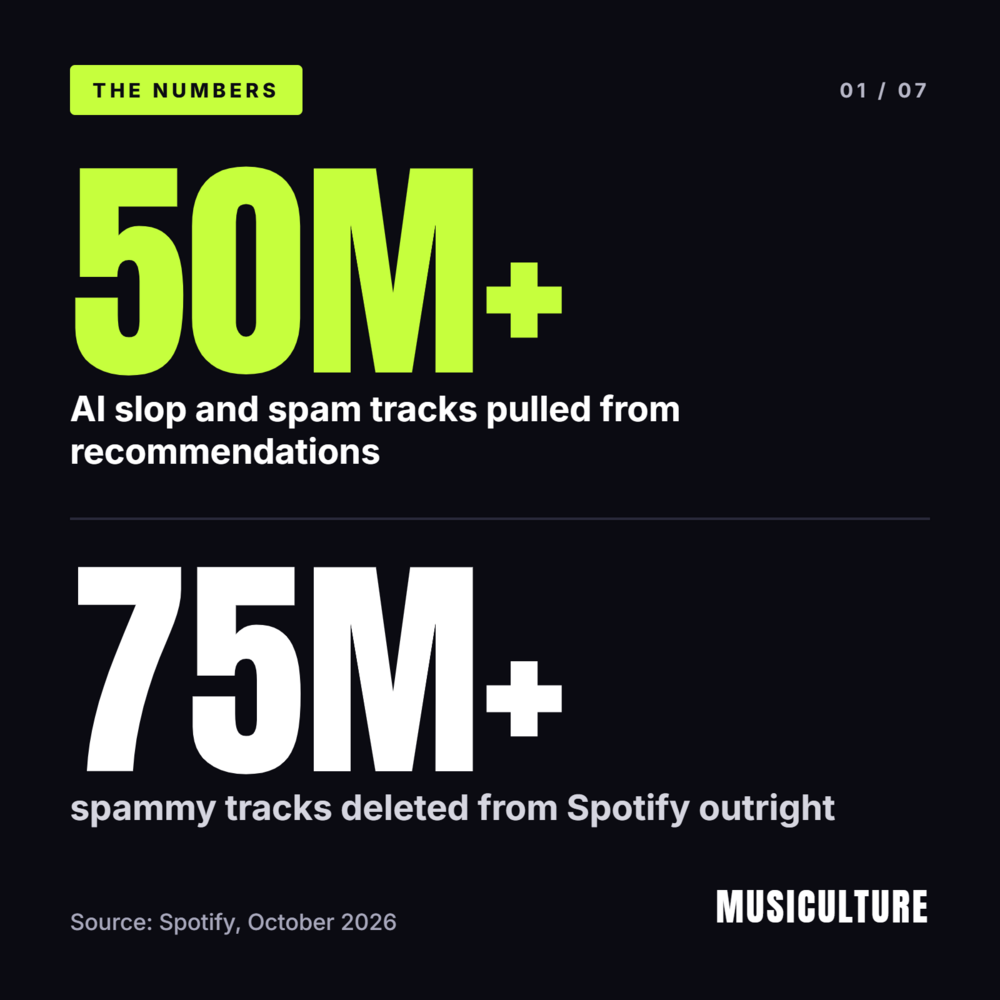
Mumbai, 24th October 2026: Open your Discover Weekly and you’d never guess a purge had happened. That’s the point. On 20 October 2026, Spotify revealed that it had quietly stripped over 50 million AI-generated slop and spam tracks from its recommendation engine in 2026 alone. Those songs still exist. You just won’t stumble onto them anymore.
It sounds like a housekeeping update. It’s actually the biggest public admission so far of how deeply AI has flooded streaming, and it lands in the same month that AI artists are signing record deals and the world’s biggest labels are fighting an AI company in court.
The numbers behind the purge
Fifty million is only half the story. Spotify says the 50 million demoted tracks come on top of more than 75 million spammy tracks it deleted outright for serious or repeated rule-breaking.
The trigger was listener behaviour. Earlier this year Spotify studied the songs people kept skipping, ignoring or flagging as unwanted, and found they were overwhelmingly the ones its systems had already marked as slop or spam. Spotify did not say how many of the 50 million were AI-made versus other kinds of spam.
The wider flood is staggering. French streamer Deezer was detecting about 10,000 fully AI-generated uploads a day in January 2025. By June 2026 that had climbed to nearly 90,000 a day, more than half of all new music delivered to the platform on peak days.
How do you spot a fake song?
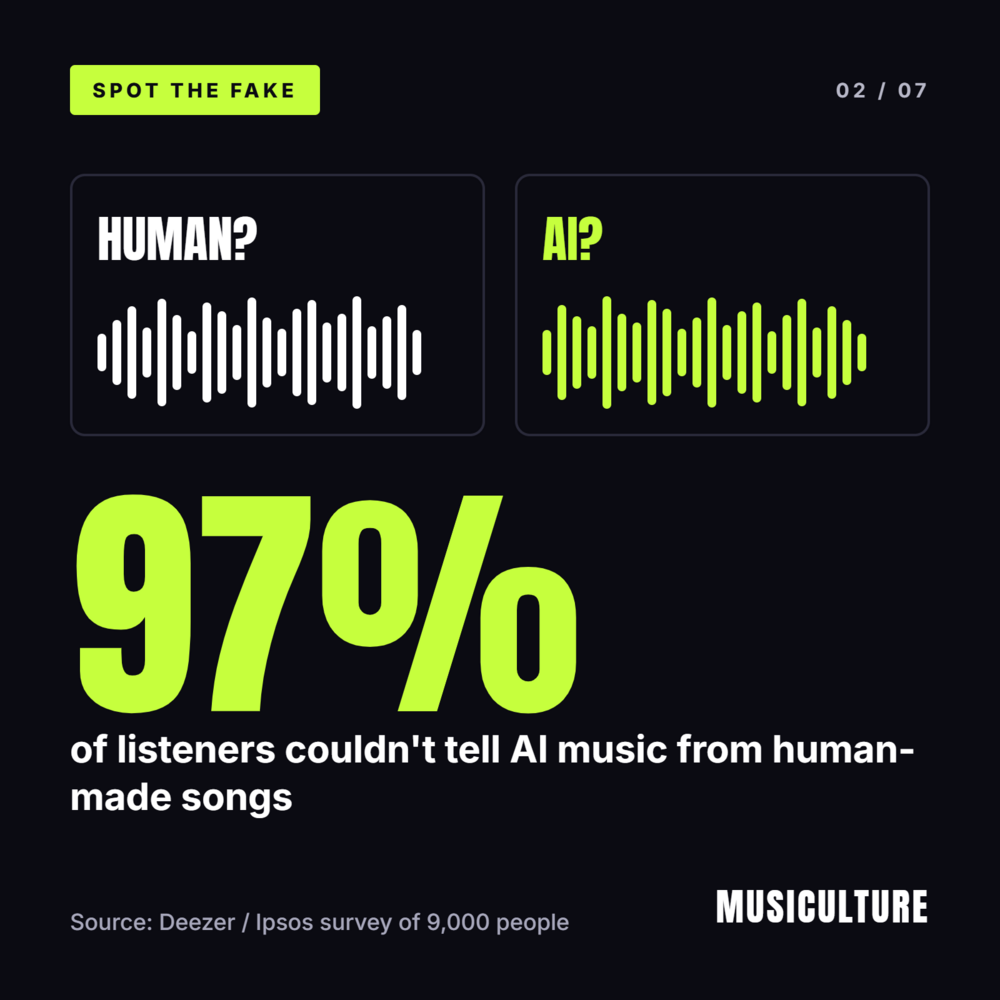
Your ears probably can’t. In a blind test of 9,000 people across eight countries, run by Ipsos for Deezer, 97% couldn’t tell fully AI-generated tracks from human-made ones.
So platforms look at behaviour, not just sound. Spotify says no single signal is enough, so it combines listener engagement, upload patterns, metadata and several third-party AI detectors. It also hunts for tell-tale tactics: mass uploads, duplicates, SEO tricks, spammy playlist networks and artificially short tracks.
Spotify admits the job will only get harder as generative AI improves. That’s why it is also leaning on labels: “AI Persona” badges for synthetic artists, and AI Credits that show which parts of a track were machine-made.
Why it’s really about money
This isn’t mainly a taste war. It’s a royalty war. The main targets are schemes where one person generates hundreds or thousands of AI songs, uploads them, then uses bots to stream them and collect fraudulent payouts.
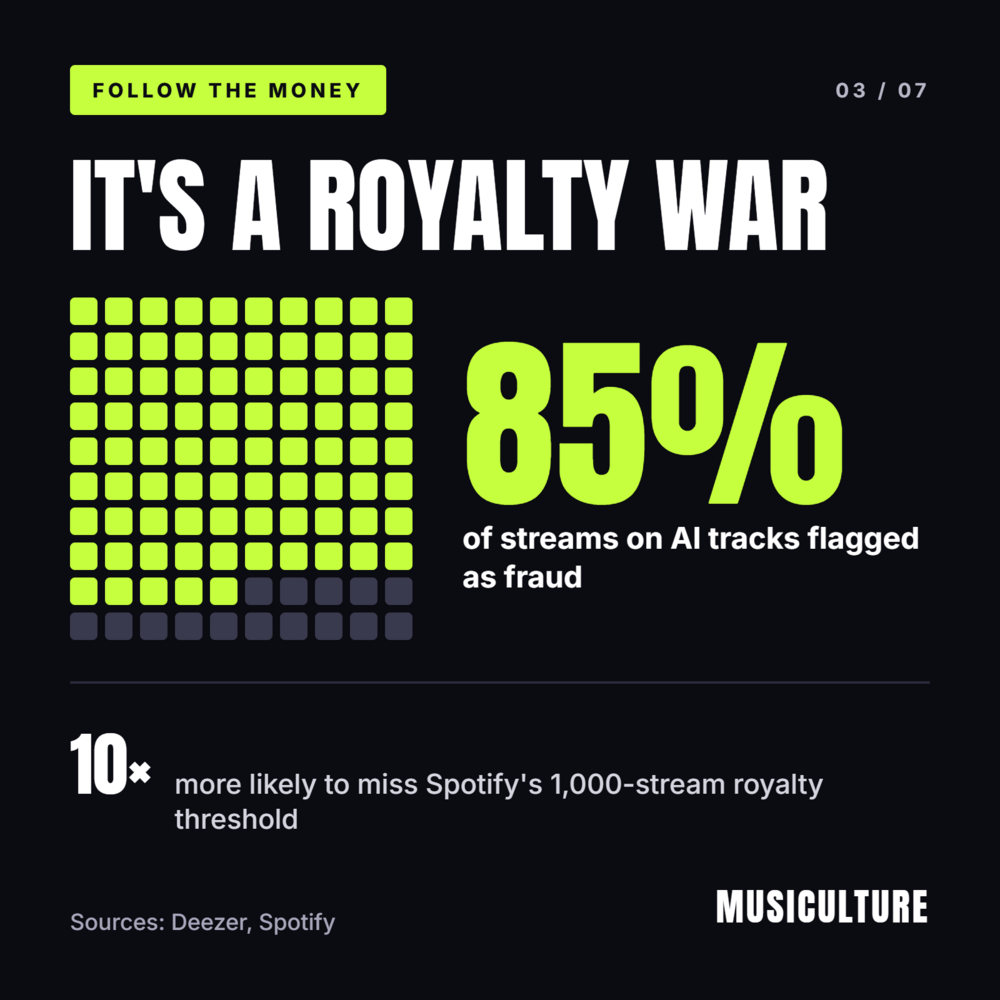
The data backs that up. Deezer said in April that it flags 85% of streams on AI tracks as fraudulent and pays no royalties on them. Every fake stream takes a slice from the same royalty pool that pays real musicians.
Spotify says tracks likely to be AI-generated are ten times more likely to fall below its 1,000-streams-a-year royalty threshold. In other words: lots of uploads, very few genuine fans.
Meanwhile, AI “artists” are charting
Here’s the twist: while platforms bury the spam, some AI acts are breaking through on purpose.
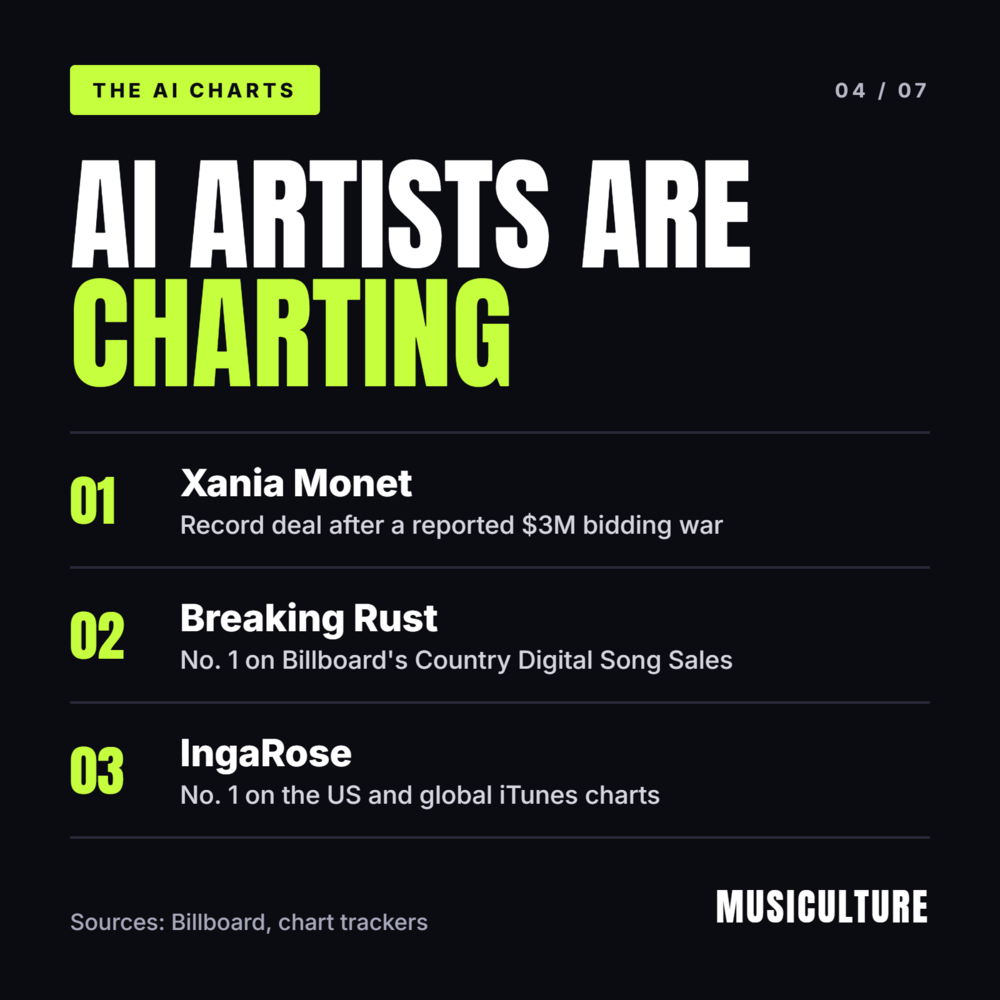
Xania Monet, an R&B persona created by poet Telisha Jones using Suno, signed with Hallwood Media after a bidding war that reportedly reached $3 million. She became the first known AI artist with enough airplay to land on a Billboard radio chart.
Breaking Rust, an AI country act, took “Walk My Walk” to No. 1 on Billboard’s Country Digital Song Sales chart in late 2025.
IngaRose hit No. 1 on the US and global iTunes charts in April 2026 with “Celebrate Me,” a Suno-made single.
There’s an important caveat. As of mid-2026, no fully AI act had cracked the big streaming-driven charts; the wins so far are in sales and niche charts. Human stars are pushing back too. Olivia Rodrigo has said she will never use AI in her music.
The courtroom front: Suno vs the labels
The most popular AI music generator, Suno, is at the centre of the legal fight, and the industry is split down the middle.
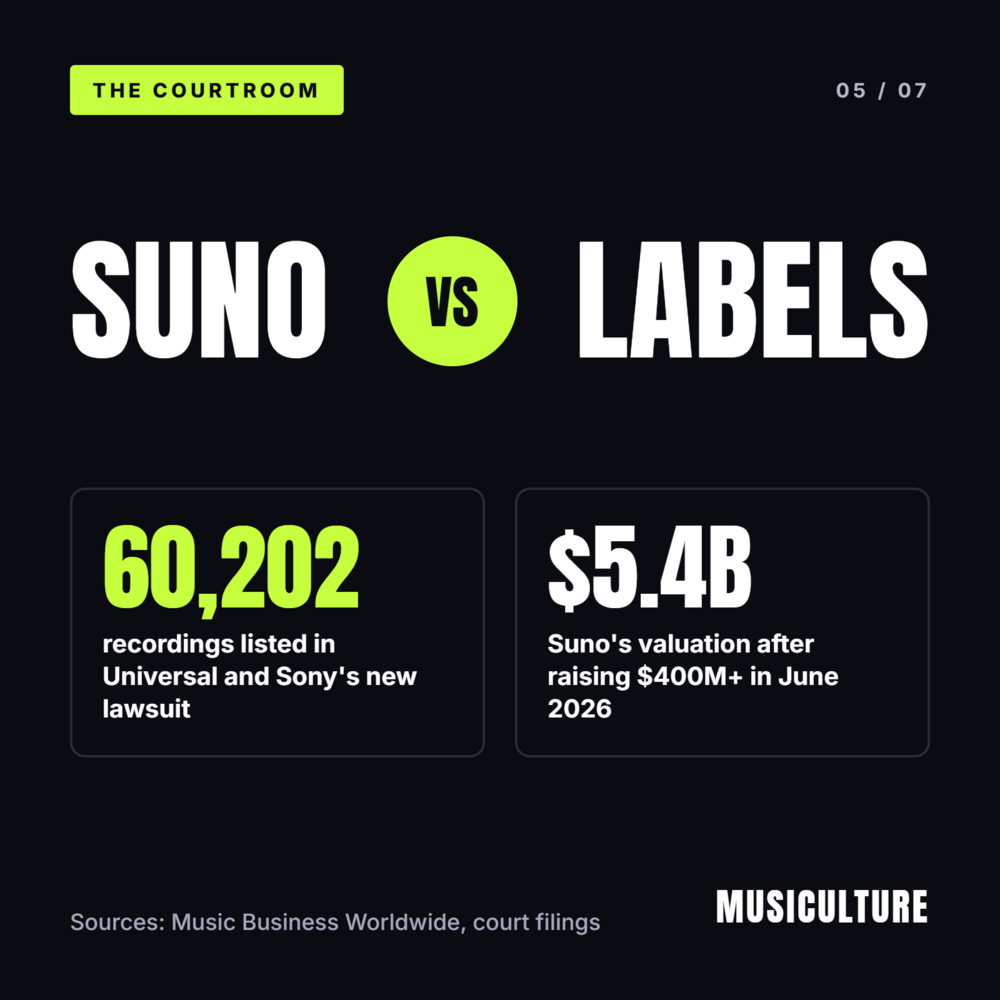
Warner Music Group settled its lawsuit in November 2025 and licensed Suno instead. On 9 September 2026 Suno launched v6, its first models trained on licensed music from Warner, BMG and Believe. Nine days later, Universal and Sony filed a fresh lawsuit in Massachusetts, arguing the “new” model was built on output from Suno’s older, unlicensed ones. That suit lists 60,202 recordings.
The pressure is coming from every direction. Canada’s SOCAN sued Suno in September over allegedly infringing outputs, and a US judge refused to dismiss a proposed class action from independent artists.
None of it has slowed the money. Suno raised more than $400 million in June 2026 at a $5.4 billion valuation (same source).
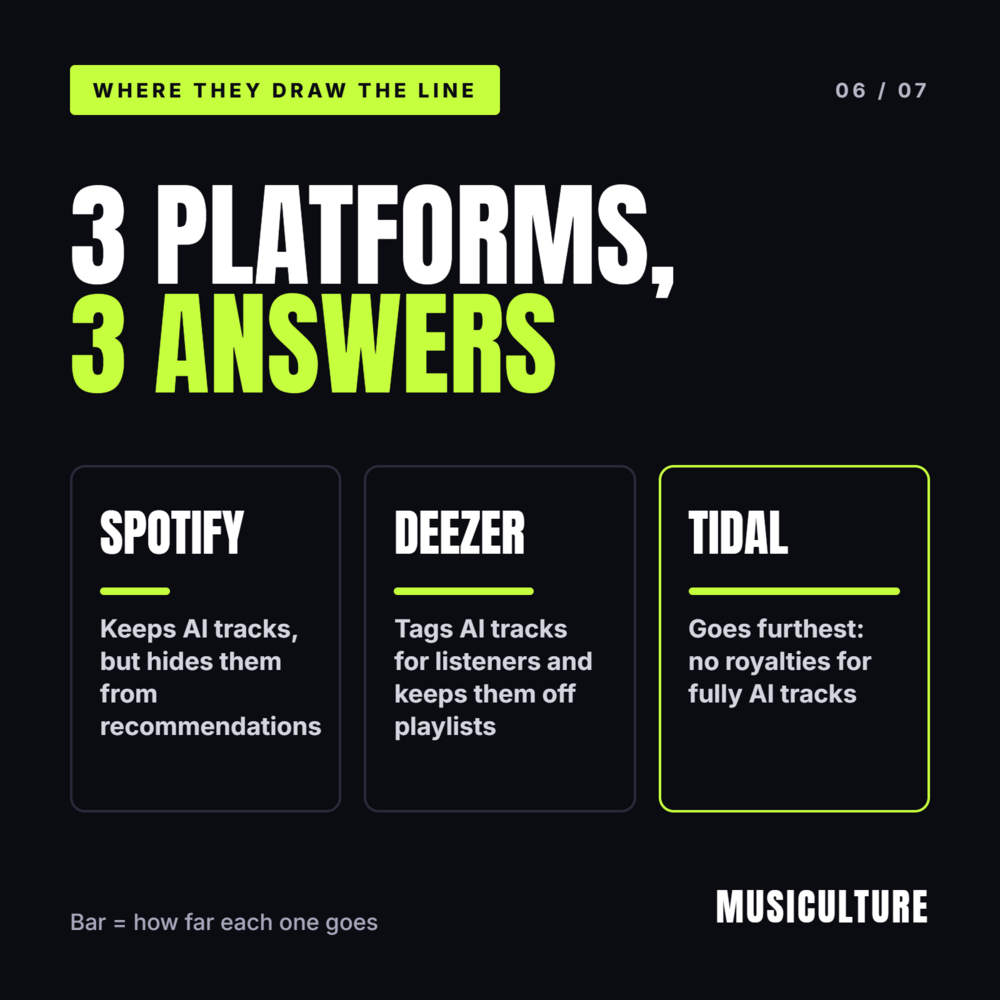
Three platforms, three answers
No streamer has banned AI music outright. Each has drawn the line in a different place.
Listeners mostly want honesty, not a ban. In Deezer’s survey, 80% said fully AI-made music should be clearly labelled, and 52% said it doesn’t belong in the main charts next to human artists.
What comes next
Spotify’s purge is a bet that listeners will keep paying for human artistry even as machines flood the catalogue. The industry has settled on a middle path: AI music can exist, but it has to be labelled, it can’t game the royalty pool, and it doesn’t get a free ride into your feed.
Three things to watch:
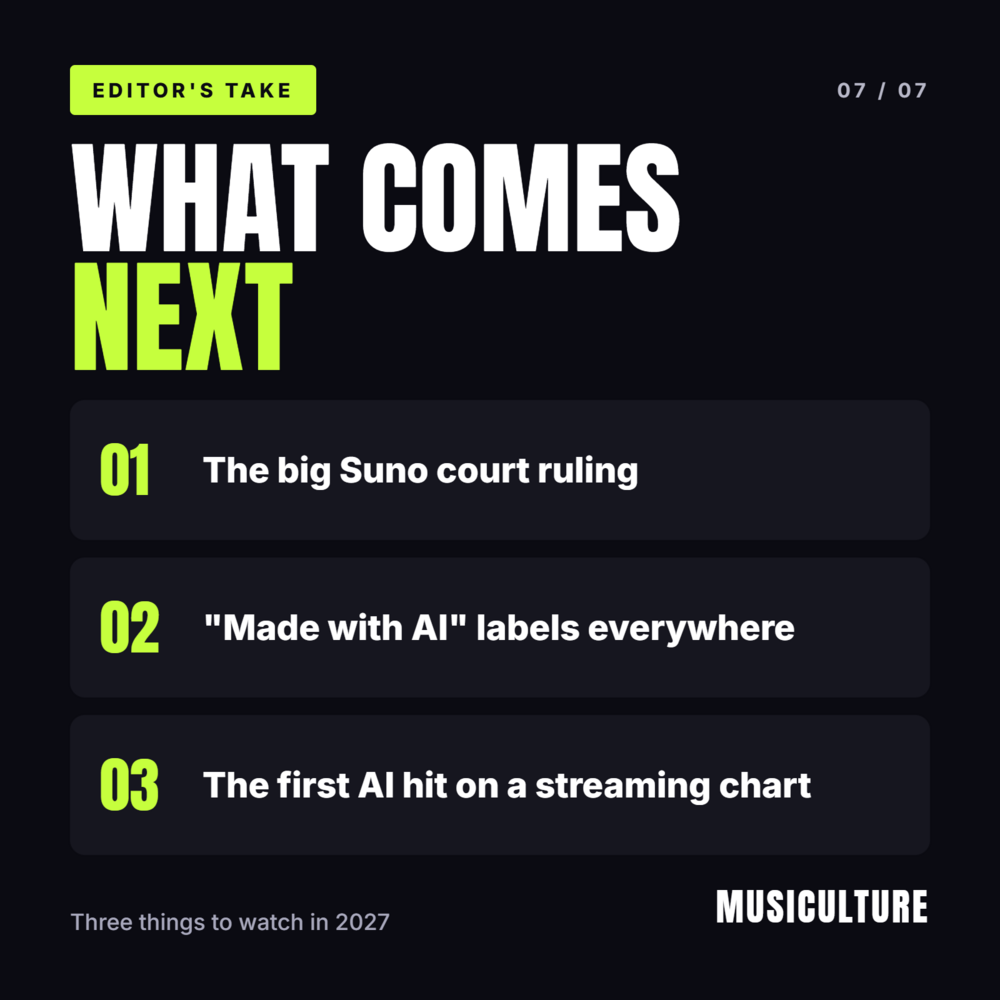
The Suno ruling. A court decision on whether AI training counts as fair use would reset the balance of power between labels and AI companies.
Labels become standard. Expect “made with AI” tags to spread across every major platform, much as Deezer and Spotify have already started.
The first AI hit on a streaming chart. Sales charts have fallen. When a fully AI act breaks into a major streaming chart, the debate starts all over again.
The real question for 2027 isn’t whether AI will make music. It already does, at a scale of tens of thousands of songs a day. The question is whether anyone will choose to listen.
