
Oct
Digital Cover
October 2026 | The Byline & The Bot: How AI Is Rewriting Music Journalism
Machines can now write the song, pick the playlist and summarise the news. So what is left for the people who write about music? More than you think, but the job will never look the same again.
Mumbai, 27th October 2026: For decades, the path from a new song to your ears ran through a person. A radio host, a magazine critic or a blogger heard it first, decided it mattered, and told you why. That chain is breaking. Today a record can be generated by software, slipped into your feed by an algorithm and summarised by a chatbot before a single human writer has pressed play.
Music journalism is standing at its biggest turning point since the internet killed the weekly music paper. AI is not replacing music writers overnight, but it is changing where stories come from, who finds them, and what readers will pay attention to. The publications that survive will be the ones that understand what machines do well, what they do badly, and what only a human can bring to the page.
The New Front Page Is A Chatbot
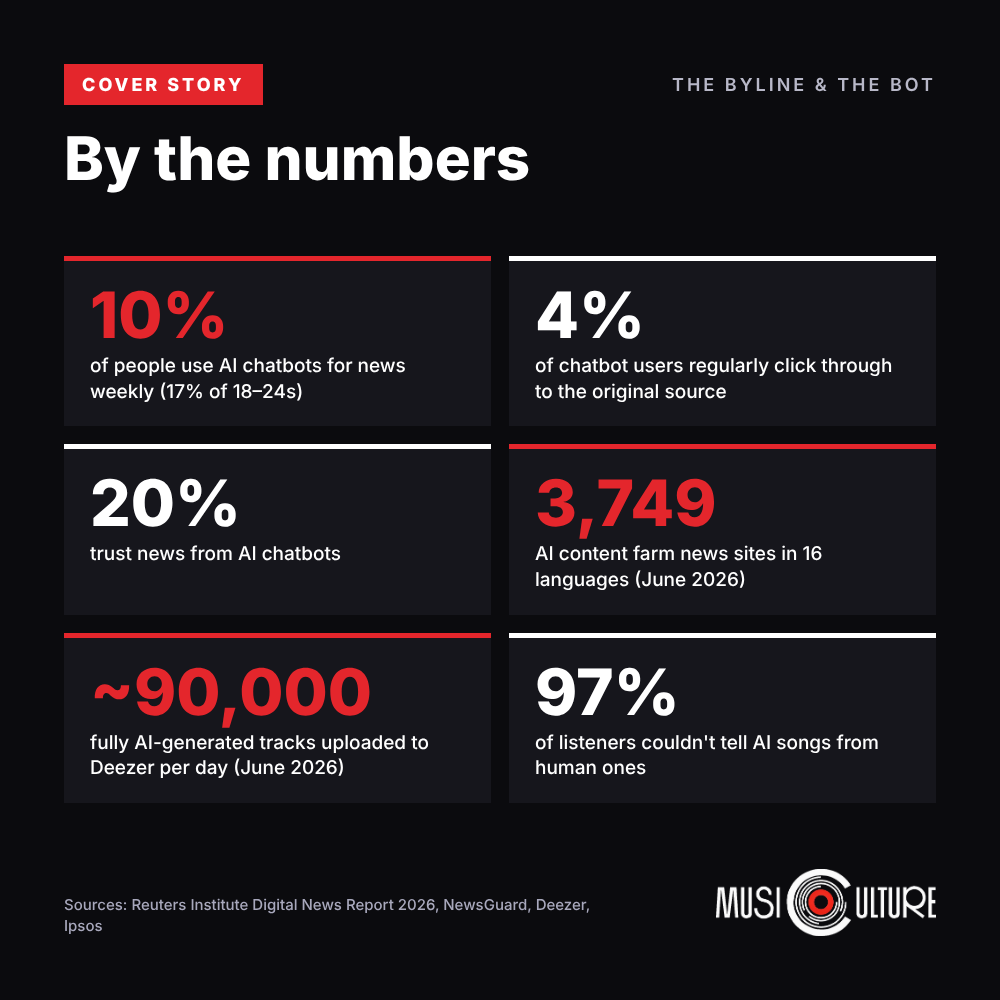
The first shift is already happening in how people find news of any kind. According to the Reuters Institute’s Digital News Report 2026, which surveyed 45 markets, 10% of people now use AI chatbots for news every week, up from 7% a year earlier. Among 18 to 24-year-olds, the core audience for music media, that figure rises to 17%.
That sounds small until you look at what happens next. Only 4% of chatbot users say they always or often click through to the original source, compared with 19% for search engines and 17% for social media. In plain terms, AI is becoming a middleman that answers the reader’s question and keeps them from ever reaching the publication that did the reporting.
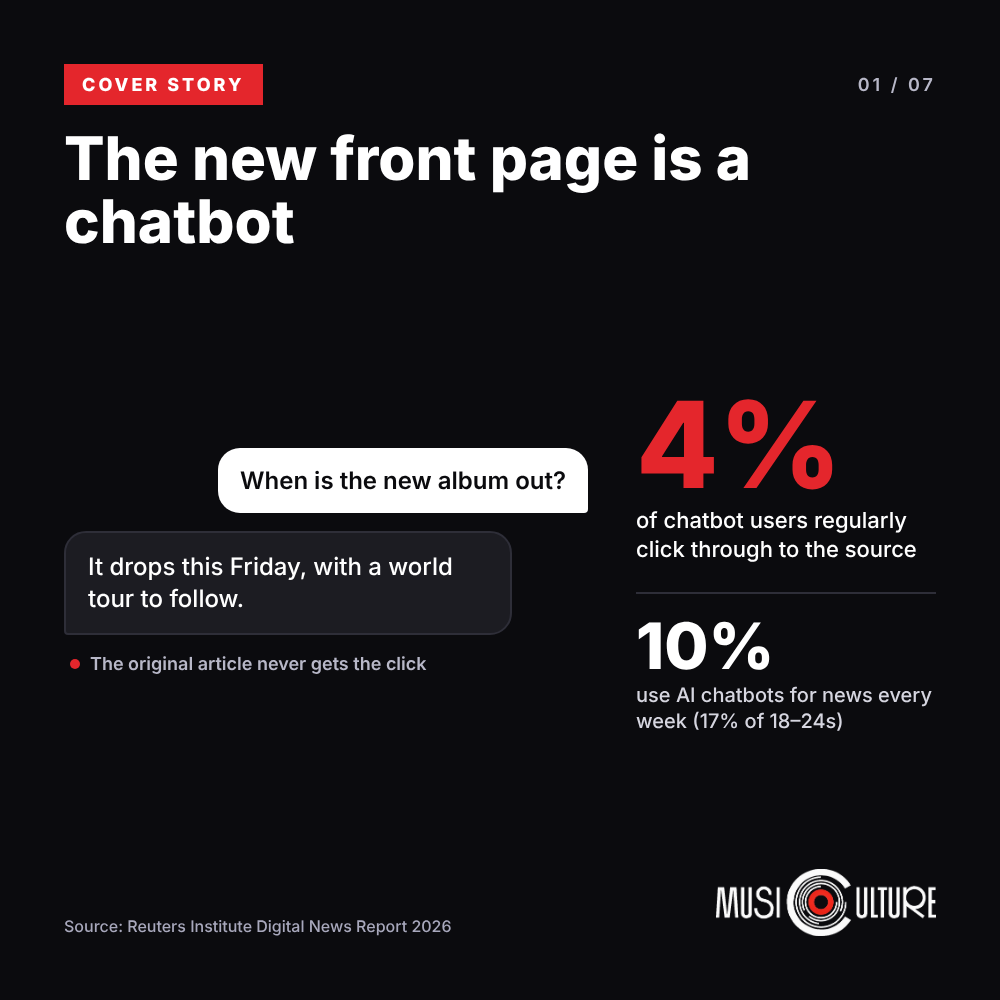
For a music site, that is a direct threat. The quick-hit stories that once drove traffic, such as release dates, tour announcements and chart positions, are exactly the facts a chatbot can repeat in one line. If a reader can ask “When is the new album out?” and get the answer instantly, the article that broke the news may never get the click.
When The Machine Holds The Pen
Newsrooms have already tried letting AI write, and the results are a warning.
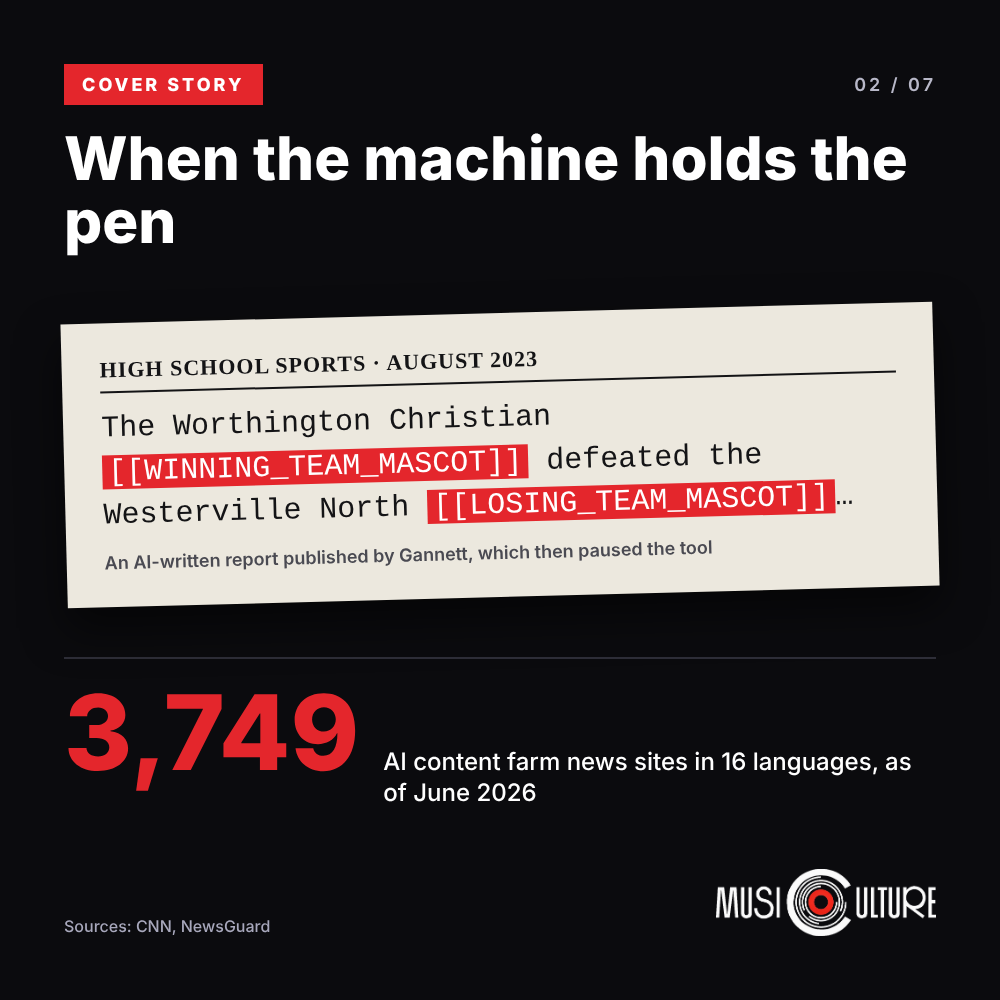
In August 2023, US newspaper giant Gannett paused an AI tool that wrote high school sports reports after readers mocked the stories online. One report in The Columbus Dispatch opened with an unfilled template: “The Worthington Christian [[WINNING_TEAM_MASCOT]] defeated the Westerville North [[LOSING_TEAM_MASCOT]].”
A few months later, in November 2023, Futurism reported that Sports Illustrated had published product articles under the names of writers who did not appear to exist. One of them, “Drew Ortiz”, had a headshot that matched an image sold on a website for AI-generated faces. The profiles were removed after the story broke.
The bigger problem is scale. NewsGuard, which tracks unreliable websites, has identified 3,749 AI content farm sites publishing news-style articles across 16 languages, as of June 2026. Many of them churn out entertainment and celebrity stories with no human checking a word. For readers, it is getting harder to tell a real music report from a machine-made copy of one.
The lesson is clear. AI can produce words at a speed no person can match, but without a human editor it gets facts wrong, misses context and quietly erodes trust.
The Critic vs The Algorithm
The second shift is about taste. For generations, the music critic’s real power was discovery: telling you which new artist deserved your time. Streaming platforms have been moving that job onto software for years, and AI is speeding it up.
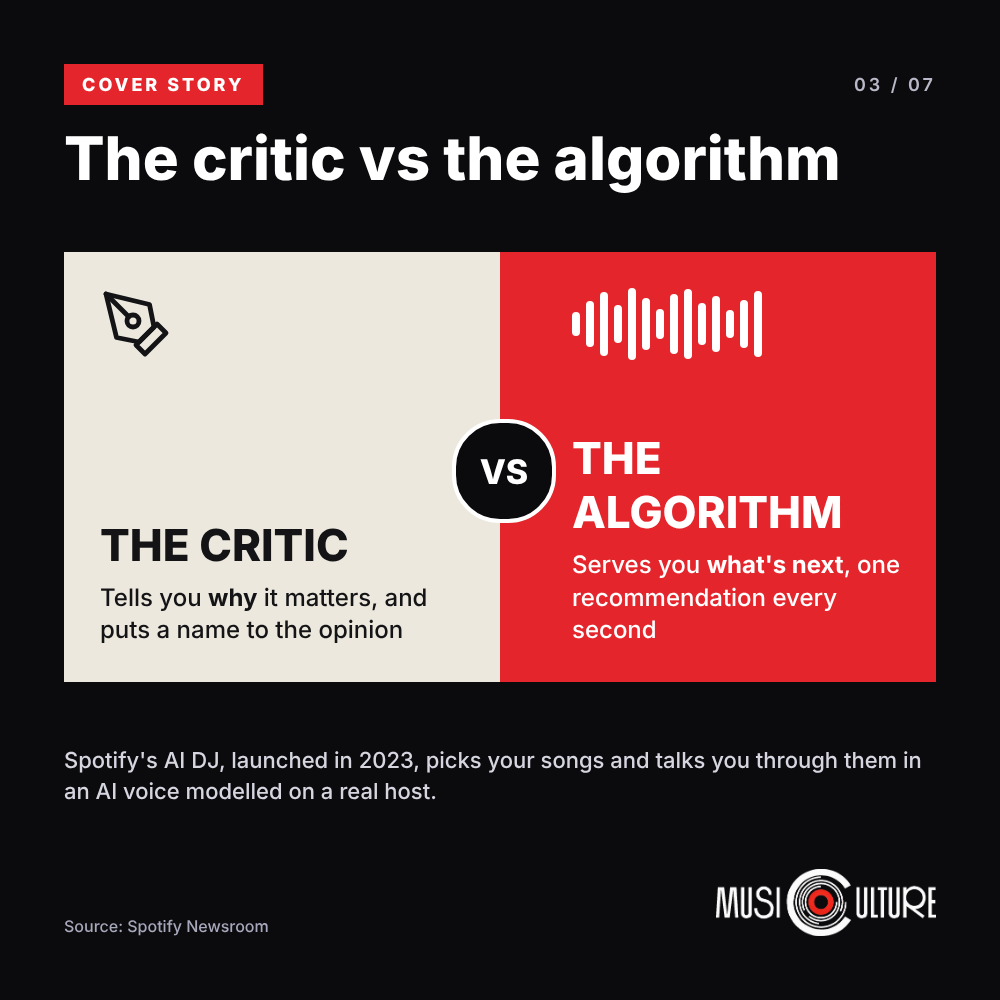
In February 2023, Spotify launched its AI DJ, a feature that picks songs for each listener and adds spoken commentary between tracks. The voice is modelled on Xavier “X” Jernigan, Spotify’s Head of Cultural Partnerships, and the scripts are written with generative AI from OpenAI. In other words, the friendly voice telling you why a song matters, the classic job of the music presenter and writer, is now partly a machine.
Spotify is careful to say people are still involved. Its music editors use AI tools to generate insights about artists and genres so their expertise can reach more listeners, and the company says the expertise of its editors is “really important” to its philosophy. That points to where the industry is heading: not human or machine, but humans whose knowledge is spread at scale by machines.
For music journalists, this changes the pitch. A recommendation alone is no longer special, because an algorithm can serve one every second. What readers still need is the why: the context, the story behind the song, and an honest opinion from someone they trust.
Drowning In Songs Nobody Made
The third shift is the sheer volume of music. In January 2025, the streaming service Deezer was receiving about 10,000 fully AI-generated tracks a day. By June 2026 that had grown to nearly 90,000 a day, more than half of all new music delivered to the platform on peak days. Spotify said this month that it has pulled more than 50 million AI “slop” and spam tracks out of its recommendations in 2026 alone.
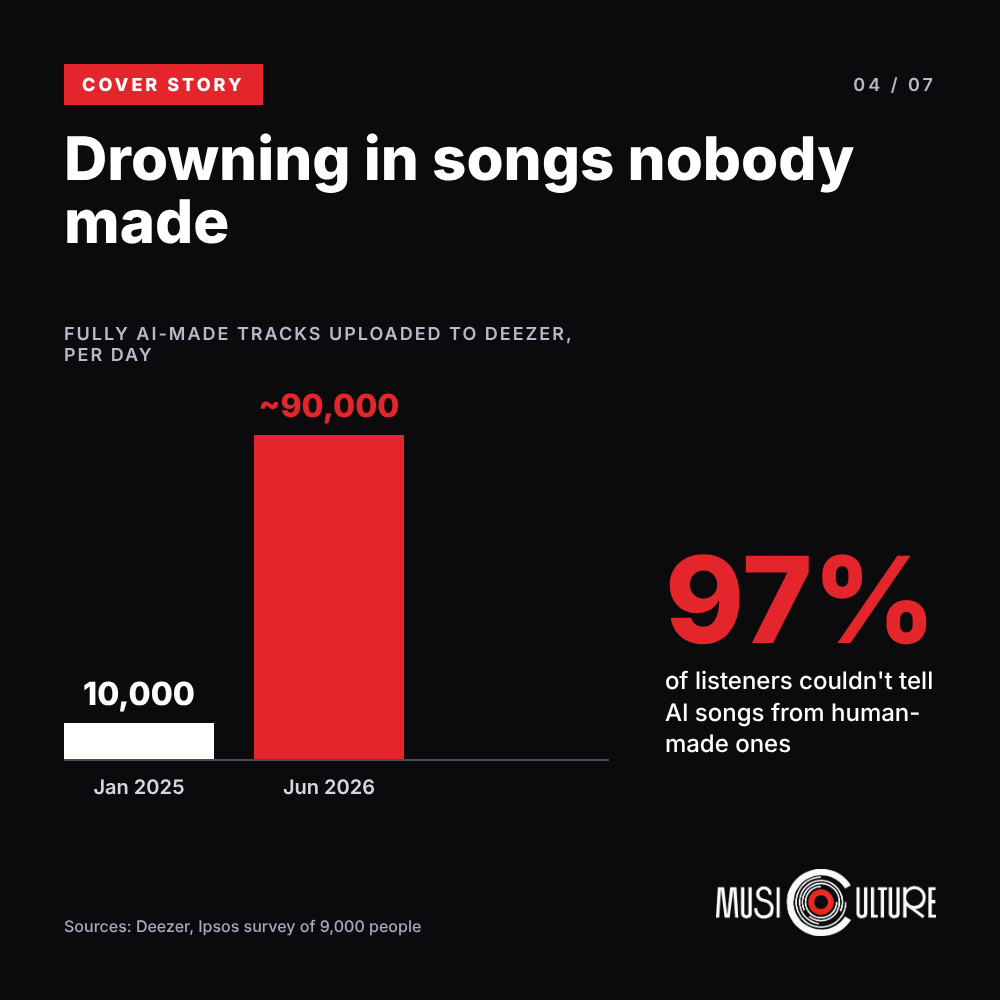
Most listeners cannot tell the difference. In a blind test of 9,000 people across eight countries, run by Ipsos for Deezer, 97% could not tell fully AI-generated songs from human-made ones.
Some of this music is pure fraud. In March 2026, Michael Smith was convicted in what has been described as the first US federal criminal case over streaming fraud. He used AI to generate hundreds of thousands of songs and bot networks to stream them, at one point earning money from more than 660,000 streams a day, and agreed to forfeit more than $8 million. A study by global songwriters’ body CISAC and PMP Strategy projects that nearly a quarter of music creators’ revenues could be at risk from AI by 2028.
And some AI acts are breaking through on their own terms. The AI R&B persona Xania Monet signed a record deal after a reported $3 million bidding war, and the Suno-made act IngaRose hit No. 1 on the US iTunes chart in April 2026.
This flood creates a new job for music journalists: verifier. When anyone can release a thousand songs a day, readers need someone to tell them what is real, who is actually behind a track, and what is worth their time. That is a role an algorithm, which can itself be gamed by bots, is badly placed to play.
What Readers Actually Trust
Here is the good news for human writers: audiences are wary of machine-made news. The Digital News Report 2026 found that only 20% of people trust news from AI chatbots. Even among people who use chatbots, fewer than half (44%) trust what they produce.
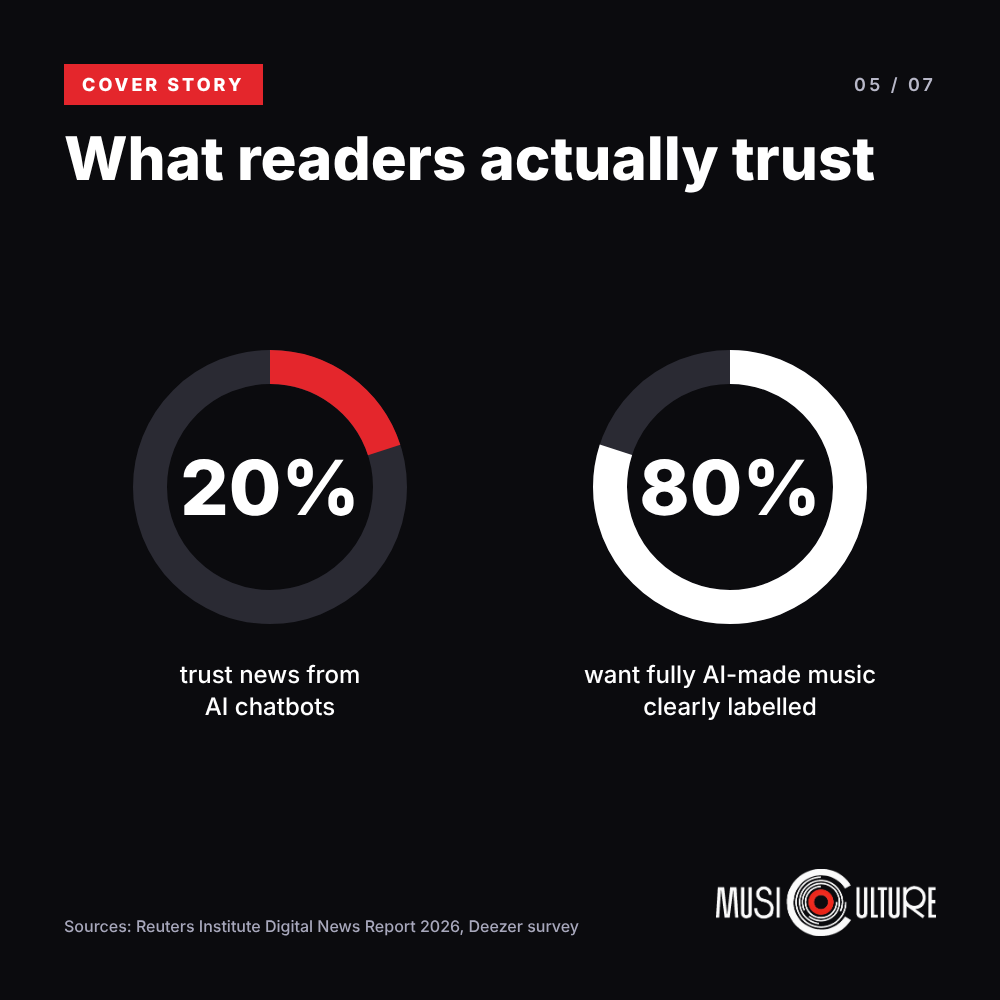
Music fans feel the same about the music itself. In Deezer’s survey, 80% said fully AI-generated music should be clearly labelled, and 52% said it does not belong in the main charts alongside human artists.
The message is consistent. People are happy to use AI as a tool, but they want to know when a machine was involved, and they still put more faith in a named person standing behind the words. Trust, not speed, is the music journalist’s biggest advantage.
What The Humans Still Own
India has already had a taste of this future. In 2023, the India Today Group unveiled Sana, described as the country’s first AI news anchor, at the India Today Conclave. The group’s Vice Chairperson, Kalli Purie, called her “intelligent, gorgeous, ageless, tireless, multilingual and completely under my control.” Sana reads daily updates and explains topics, with human anchors mentoring her. The launch showed how fast Indian newsrooms are willing to experiment, and how central human editors remain even when the face on screen is synthetic.
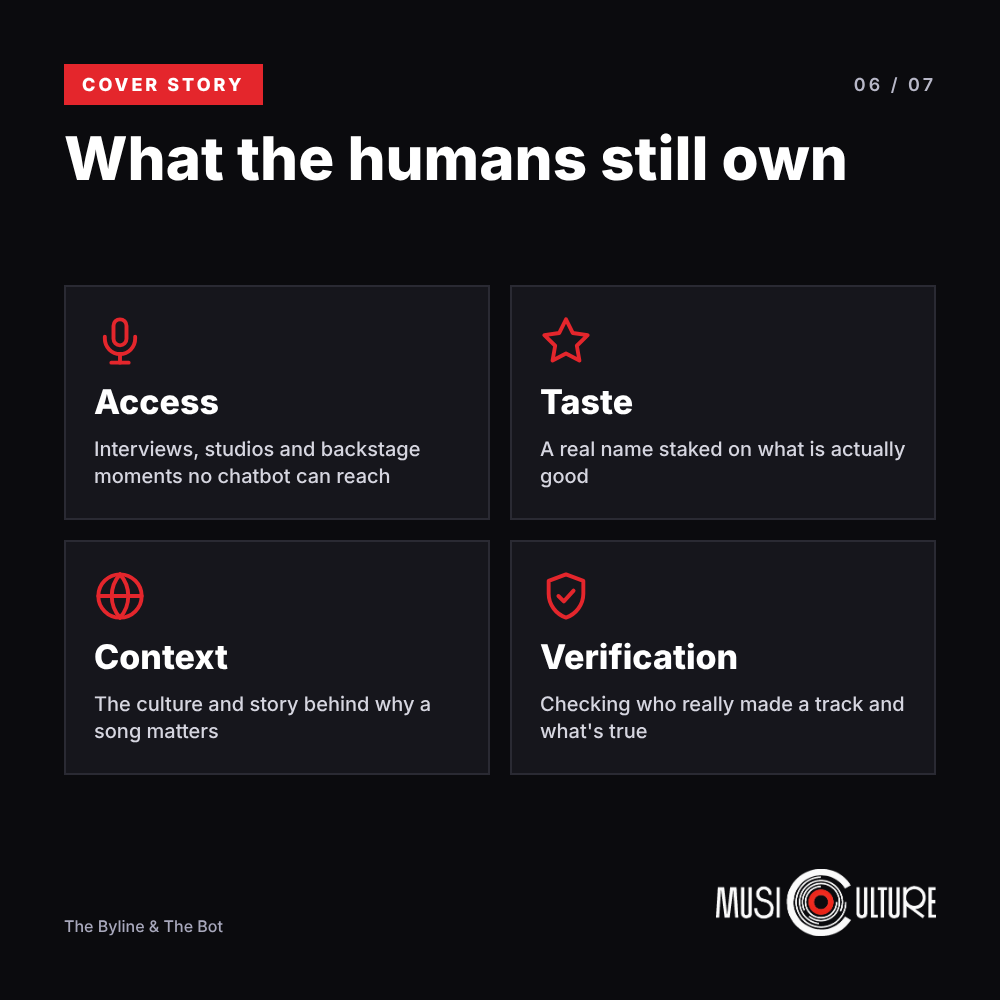
So what can a music journalist offer that a machine cannot? Four things stand out:
Access. A chatbot cannot sit in a studio with an artist, catch a backstage moment or earn a musician’s trust over years. Interviews, reporting and relationships remain human work.
Taste with accountability. An algorithm recommends what keeps you listening. A critic stakes their name on what is actually good, and readers can hold them to it.
Context and culture. Explaining why a Punjabi track blew up in Toronto, or why an indie artist matters to a scene, needs lived knowledge that no dataset fully captures.
Verification. In a world of AI-generated songs and fake websites, checking who made a track and whether a story is true becomes one of the most valuable services a publication can offer.
AI will still have a place in the newsroom. It can transcribe interviews, translate stories across India’s many languages, sort release data and draft routine updates. Used openly and checked by humans, it frees writers to spend more time on the work only they can do.
The New Job Description
The music journalist of 2027 will look different from the one of 2017. Less time rewriting press releases, because machines will do that. More time reporting, interviewing, explaining and checking. Less competing on who posts first, and more competing on who readers believe.
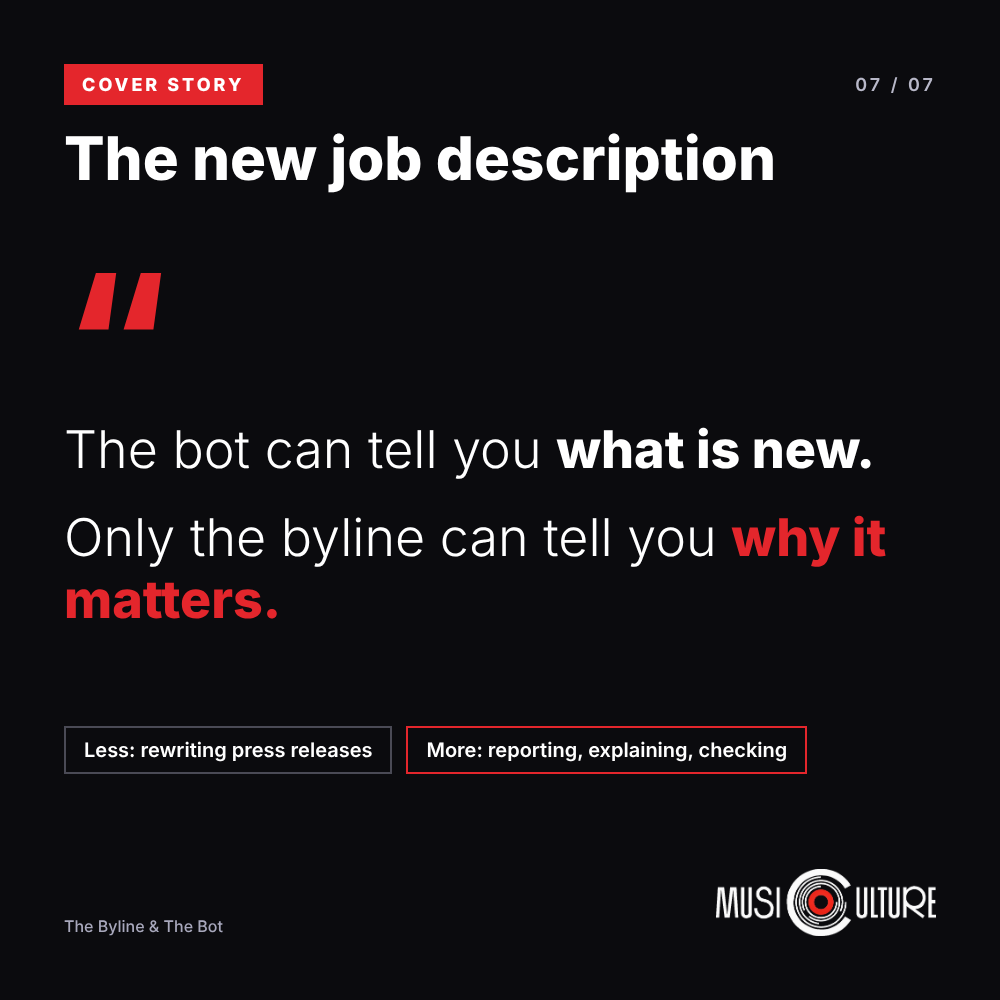
The byline is not dying. It is becoming the product. In an internet flooded with songs nobody made and articles nobody wrote, a real name attached to a real opinion may be the most valuable thing a music publication can offer. The bot can tell you what is new. Only the byline can tell you why it matters.
